Relocating a warehouse takes more planning than moving a normal office. Stock, racks, machinery, pallets, shelving, tools, and packing materials all need to reach the new site without unnecessary delays. A poor moving plan can interrupt orders and create problems with inventory control.
Packnmovers can support businesses that need organised warehouse relocation across the UAE. The work can include packing, labelling, loading, transport, unloading, and placing goods at the new location.
The first step is to understand what needs to move and how the new warehouse will receive it. Access roads, loading bays, storage areas, lift capacity, floor space, and operating hours can affect the plan.
Need to move only stock? Or does the relocation include racks, equipment, and heavy machinery too? The answer changes the crew, vehicles, tools, and time needed for the job.
When a warehouse move makes sense
Businesses may relocate when they need more storage space, lower operating costs, better access, or a location closer to customers. A growing company may outgrow a small warehouse and need a larger industrial unit.
Some businesses move because their lease is ending. Others change locations after expanding into new areas. A warehouse may need to move from one Dubai industrial area to another, or from Dubai to Abu Dhabi, Sharjah, Ajman, or another UAE emirate.
A planned relocation starts with an inventory review. We identify stock categories, fragile goods, oversized items, machinery, racks, pallets, and equipment that require special handling.
Why move everything at once if doing so could stop daily operations?
A phased move can work better for businesses that must continue serving customers. One storage area can move first while another remains active. This approach can reduce the effect on order processing.
Warehouse location matters too. Areas such as Al Quoz, Ras Al Khor, Jebel Ali, Dubai Investment Park, Mussafah, and Sharjah Industrial Area have different access conditions and traffic patterns.
Types of warehouse relocation services
Warehouse moves can range from simple stock transfers to large industrial relocations. The right service depends on the size of the site, the goods stored there, and the equipment involved.
For smaller warehouses, the main work may involve cartons, pallets, shelving, and office items. Larger facilities may require forklifts, lifting equipment, specialist vehicles, and experienced handling crews.
Industrial Moving Services can cover heavier warehouse equipment and machinery. This type of work needs careful planning because machinery can be heavy, difficult to access, and costly to replace.
Common warehouse relocation work includes stock packing, pallet movement, rack dismantling, equipment handling, loading, transport, unloading, and placement at the new site.
Here is a practical comparison:
| Service type | Suitable for | Main requirement | Relative cost |
| Stock relocation | Boxes and packaged goods | Packing and labelling | Low |
| Pallet relocation | Bulk warehouse stock | Pallet handling | Medium |
| Rack relocation | Storage shelving | Dismantling and rebuilding | Medium |
| Machinery relocation | Industrial equipment | Lifting and specialist handling | High |
| Full warehouse move | Complete facility | Coordinated moving plan | High |
Stock condition should guide the packing method. Fragile goods need stronger cartons and internal protection. Heavy goods need suitable pallets and secure wrapping.
Racks should be inspected before dismantling. Damaged frames or bent beams should not simply be moved and reused without checking their condition.
How a warehouse move works
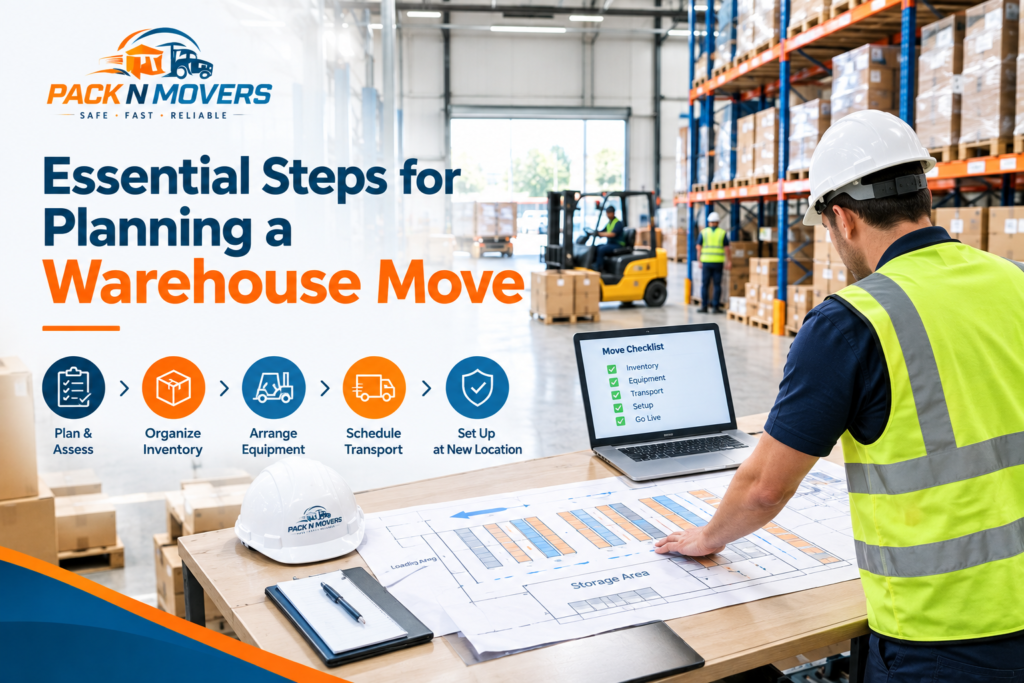
The process should begin with a site survey. We review the current warehouse, the destination, access points, loading areas, storage zones, and the items that need moving.
Next comes the inventory plan. Stock can be grouped by product type, destination area, handling needs, or priority. Clear labels help the receiving team identify goods quickly.
Packing follows the agreed plan. Boxes should have readable labels, and pallets should remain stable during handling. Fragile products need suitable protection before loading.
Rack dismantling requires care. Shelves, beams, frames, bolts, and fittings should be grouped together so the system can be rebuilt without missing parts.
Heavy machinery requires a separate handling plan. The team should check its weight, dimensions, lifting points, route, and vehicle requirements before moving it.
Loading should follow a planned sequence. Items needed first at the new warehouse should be easy to access after unloading.
At the new site, goods should go into assigned areas rather than being left in random locations. This makes stock control easier and reduces the time needed to restart operations.
Consider a warehouse in Jebel Ali that needs to move to a larger facility in Dubai Investment Park. The company may keep daily orders running from one section while stock from another section moves first. Racks can then be rebuilt before the remaining goods arrive.
Warehouse moving costs in the UAE
Warehouse relocation prices vary widely because every facility has a different amount of stock and equipment. A small stock transfer will not have the same cost as a complete industrial relocation.
The distance between locations affects transport costs. A short move within Dubai may need less driving time than a move between Dubai and Abu Dhabi.
Labour is another major cost. More workers may be needed when the warehouse contains many pallets, racks, machines, or heavy goods.
Vehicle type matters too. Standard trucks may suit cartons and pallets, but oversized machinery may need specialist transport.
Access can increase the work involved. Narrow loading areas, stairs, restricted parking, limited loading hours, or long carrying distances can add labour time.
Packing materials add another cost. Cartons, stretch film, bubble wrap, pallets, straps, labels, and protective sheets may be required depending on the stock.
Businesses should ask for a detailed quotation rather than a single total figure. The quote should state labour, transport, packing, dismantling, equipment, waiting time, and rebuilding charges where applicable.
For a warehouse move in Dubai, Abu Dhabi, Sharjah, Ajman, Al Ain, Ras Al Khaimah, Fujairah, or Umm Al Quwain, local access rules can affect scheduling.
UAE workplace safety rules address risks linked to manual handling and moving loads. Administrative Decision No. 19 of 2023 states that employers should avoid assigning heavy manual handling where injury risk may increase and should consider suitable lifting or traction equipment.
That guidance matters when workers handle heavy machinery, pallets, or large warehouse equipment. Proper equipment can reduce unnecessary manual lifting.
How to choose a warehouse moving company
A warehouse relocation provider should understand more than basic household moving. Commercial stock needs careful counting, labelling, handling, and placement.
Ask how the company will protect inventory during loading and transport. Find out whether fragile goods receive separate packing and whether pallets are secured before transport.
Insurance should be discussed before work begins. Ask what cover applies to stock, machinery, building surfaces, and transport.
The company should provide a clear moving schedule. A good schedule identifies packing dates, loading times, transport windows, unloading periods, and the expected restart time.
Experience with industrial locations can help. Companies like Packnmovers can plan warehouse relocation around access restrictions, loading areas, stock handling, and equipment movement.
For heavier facilities, a provider familiar with Industrial Moving Services can assess machinery weight, lifting points, vehicle needs, and the route before work begins.
Ask about equipment too. Depending on the job, the provider may need pallet trucks, forklifts, lifting equipment, ramps, straps, protective materials, and suitable transport vehicles.
Do you have a backup plan if a loading bay becomes unavailable? What happens if the new warehouse cannot receive the full shipment at the planned time? These questions should be answered before moving day.
A written inventory can protect both sides. Record the number of pallets, major machines, racks, fragile items, and special handling requirements.
Conclusion
A warehouse relocation works better when stock, equipment, labour, vehicles, and site access are planned together. The right approach can reduce downtime and make the new facility easier to organise.
Start by listing everything that needs to move. Separate ordinary stock from fragile goods, racks, machinery, and oversized items. Then confirm access conditions at both properties.
A clear quotation should cover the full scope of work. This gives your business a better view of the expected cost and schedule.
If you are planning a warehouse move anywhere in the UAE, contact Packnmovers with your current and new warehouse details. A clear assessment can help you decide which moving services fit your operation.
FAQs
How much do Warehouse Moving Services cost in Dubai?
The price depends on warehouse size, stock volume, distance, labour, packing, vehicles, racks, and machinery. A small stock transfer may cost much less than a full warehouse relocation. Ask for an itemised quotation covering packing, loading, transport, unloading, and equipment.
What do Warehouse Moving Services include in Abu Dhabi?
Services can include inventory preparation, packing, labelling, pallet handling, loading, transport, unloading, rack dismantling, and equipment placement. Abu Dhabi warehouse areas can have different access conditions, so the provider should check loading space, vehicle access, working hours, and site requirements before moving day.
Are Industrial Moving Services available for heavy machinery in the UAE?
Yes, heavy machinery can require specialist handling based on weight, dimensions, lifting points, and access. The provider may need lifting equipment, suitable vehicles, straps, ramps, or forklifts. Machinery should be assessed before moving so the crew can plan the correct handling method.
Do warehouses in Dubai need permits for relocation work?
Some industrial and managed properties may have their own access rules, loading restrictions, security procedures, or booking requirements. Check with the warehouse management before moving day. The moving company should know the planned loading times and any site instructions before arriving.
How long does a warehouse move take in the UAE?
There is no fixed time because warehouse size, stock volume, distance, equipment, and access all affect the schedule. A small stock transfer may take a day, while a large facility can require several stages. A site survey gives a more useful estimate.